 info@elancianoreydelosvinos.es
 (+34) 91 559 53 32
Madrid is full of churches, hermitages, parish churches, oratories, and chapels. Some are emblematic, others are virtually unknown, whose heritage, secrets, and interesting facts are worth discovering. We present some of them.
Church of San Antonio de los Alemanes
Popularly known as the Sistine Chapel of Madrid, it is located at 22 Calle de la Puebla. The Church of San Antonio de los Alemanes was built between 1624 and 1633. However, the interior decoration we see today was added forty years later.
In its early days, along with the adjacent hospital, it was dedicated to caring for the sick and Portuguese pilgrims passing through Madrid. For this reason, the church was originally called San Antonio de los Portugueses.
With the independence of Portugal in 1640, the church fell into disuse. Later, Mariana of Austria, wife of Philip IV, promoted the transfer of the temple and hospital to care for soldiers from the king’s regiment and Germans. Hence its name change to Saint Anthony of the Germans.
The church, which Philip V once called “the jewel in the crown” for its interior beauty and which was declared a national historic-artistic monument in 1972, offers worship in the evenings and is open to tourist attractions in the mornings.

German Church of Peace (Friedenskirche)
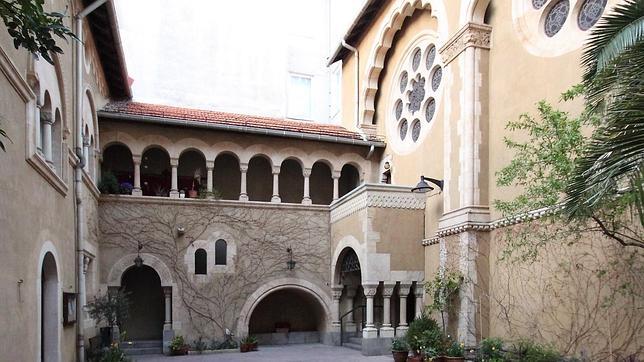
Did you know that a church is hidden behind the wall at number 6 Paseo de la Castellana?
The Church of Peace was built between 1907 and 1909 by order of Wilhelm II (the last Kaiser of the German Empire) and has since housed a Protestant congregation. The site chosen was the adjacent German embassy building.
The reason the German Evangelical Church is not visible from the outside is because at the time of its construction, Protestant worship was frowned upon in Madrid, and they avoided building towers or prominent elements that could be seen from the outside.
Inside, the image of Christ Pantocrator is located in the vault of the apse, and the two Gothic rose windows adorned with stained-glass windows on the main façade. Also notable is the Visigothic-style lamp, located above the pews to emphasize the importance of the faithful, and a pulpit, large for the size of the church, carved by Riegelmann.
The temple is riddled with columns, whose carved capitals depict a variety of symbols: eagles, lions, man-eating monsters, and Emperor Wilhelm II. In addition, a portrait of Martin Luther hangs in one of the galleries.
Real Basílica de San Francisco El Grande
This monumental neoclassical basilica stands out for its artistic richness within, with paintings by Goya and Zurbarán. Furthermore, its dome is the largest in Spain and the fourth largest in Europe.
The church was built on the land offered to Saint Francis of Assisi after his visit to Madrid in 1214 during his pilgrimage to Santiago de Compostela. Three subsequent churches were built on the same site during the 17th century.
Between 1761 and 1784, after the church was demolished in 1760, Francisco Cabezas and Francesco Sabatini built the one we can see today. Furthermore, in 1980, it was declared a National Monument.

Iglesia de San Ginés
In the heart of Madrid, we find one of the oldest churches in the capital, and one of the most storied and legendary within its walls.
It was built in 1645 and, according to legend, on the remains of a Mozarabic hermitage.
Its current main façade, made of brick and stone in 1870, was originally in the Plateresque style, although after being destroyed during the Civil War, its original decorations were removed following the restoration carried out after the conflict.
The Church of San Ginés stands out, above all, for its artistic heritage. Many faithful and tourists come to visit this place daily, witnessing, among other events, the baptism of Quevedo and the marriage of Lope de Vega. They also come to admire emblematic works inside, such as The Purification of the Temple by El Greco, or to venerate and pray for favors from the figure of Saint Jude Thaddeus.

